
Artificial Intelligence is no longer the stuff of science fiction. Today, it’s a practical tool for businesses of all sizes, from scrappy startups to established enterprises. But as more organizations rush to implement AI-powered solutions, a crucial question emerges: how do you actually measure the return on investment (ROI) from AI integration? At Digital Minds, we’ve helped countless clients launch and scale AI projects, and we know firsthand that successful adoption is about more than just shiny technology. It’s about making sure every dollar invested yields tangible, sustainable value.
In this article, we’ll walk through a practical, growth-oriented approach to evaluating AI integration ROI. Whether you’re considering a custom web platform with predictive analytics, automating workflows in your mobile app, or enhancing your SaaS product with intelligent features, understanding ROI is essential for making sound, strategic decisions.
Defining AI ROI: It’s More Than Just Savings

The classic ROI formula—gain from investment minus cost of investment, divided by cost of investment—still applies when you’re talking about AI. But in practice, AI ROI is a bit more nuanced. Unlike traditional software projects, AI integration often produces both direct and indirect benefits. Think cost reductions, but also time savings, process improvements, new capabilities, and even competitive differentiation.
For example, automating a manual data entry process with AI might cut labor costs by 30%, but it could also reduce human error, speed up delivery, and free your team to focus on higher-value tasks. These “soft” benefits are harder to quantify but can be just as valuable as hard cost savings.
Pro tip: When scoping an AI project, create a list of both direct (quantifiable) and indirect (qualitative) benefits. This gives you a more complete picture of potential ROI and helps align project goals with business outcomes.
Calculating the True Cost of AI Integration
Before you can measure ROI, you need to know your total investment. AI projects often involve more than just software development costs. Consider the following:
- Technology and infrastructure: Cloud services, APIs, and computing resources—especially for training and running machine learning models.
- Talent and expertise: Do you need external consultants, data scientists, or upskilling for your existing dev team?
- Data readiness: Cleaning, labeling, and securing data can be a significant upfront investment.
- Change management: Training users, updating workflows, and supporting adoption all require time and resources.
- Ongoing support and maintenance: AI models need to be monitored, retrained, and improved over time.
For Digital Minds clients, leveraging reliable overseas development teams can help manage costs without sacrificing quality, especially during MVP launches. But don’t forget to factor in long-term support and scaling as your AI solution matures.
Pro tip: Break down your AI project costs into one-time and recurring categories. This helps you model ROI over the project’s expected lifetime, not just at launch.
Measuring Hard and Soft Returns
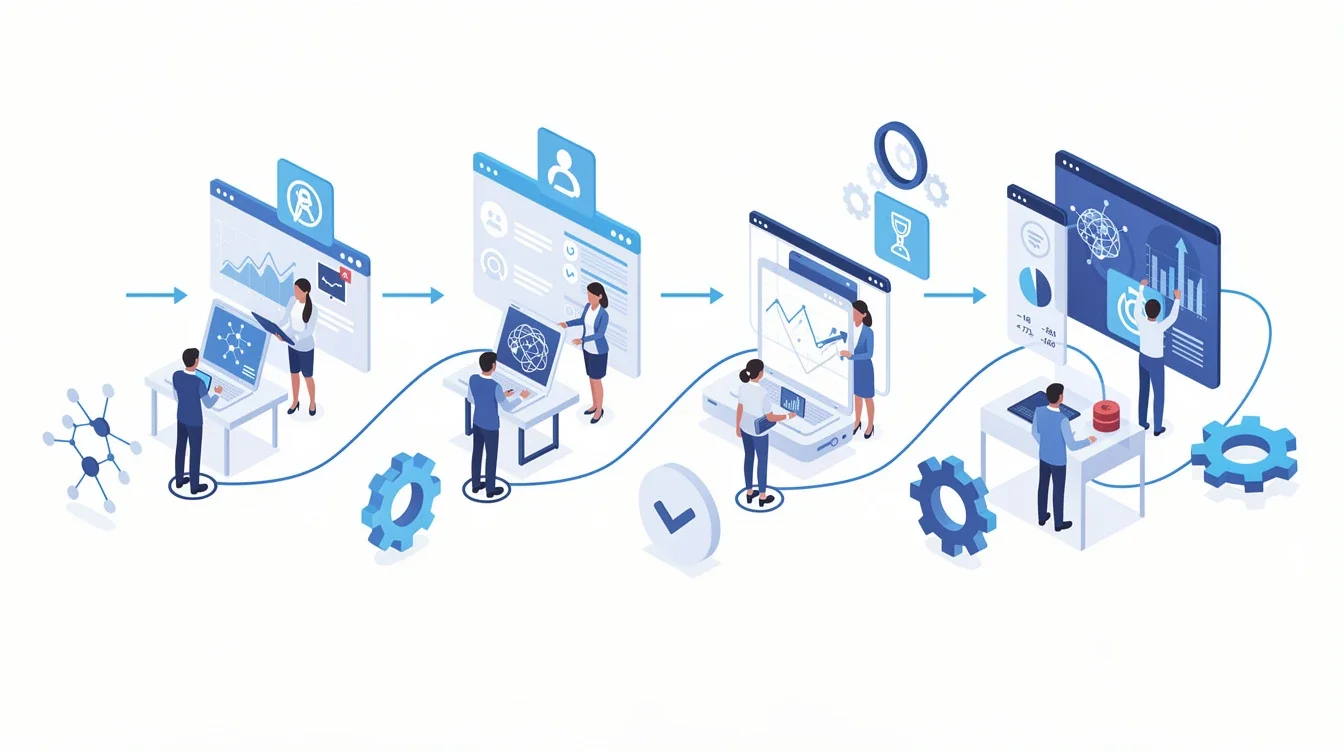
Once your AI solution is live, it’s time to track results. The most obvious wins are usually in operational efficiency—less time spent, fewer errors, lower costs. But some of the most impactful returns come in less tangible forms.
Hard returns might include:
- Reduced processing times or costs
- Increased sales from smarter recommendations
- Fewer support tickets due to improved self-service
Soft returns could be:
- Higher employee satisfaction from automating tedious work
- Improved customer experience thanks to faster response times
- Better data-driven decision making
For example, a SaaS platform that uses AI to personalize onboarding could see both a measurable increase in user retention (hard ROI) and a boost in customer satisfaction scores (soft ROI).
Pro tip: Pair your quantitative metrics (like cost savings or revenue gains) with qualitative feedback from users and stakeholders. This holistic view helps demonstrate the full value of your AI investment.
Setting Realistic Benchmarks and KPIs
It’s easy to get swept up in AI hype and set ambitious goals. But for a practical, cost-conscious ROI evaluation, you’ll want to define clear, achievable key performance indicators (KPIs) from the outset. These might include:
- Percentage reduction in manual processing time
- Increase in sales conversions or upsells
- Improvement in customer satisfaction (NPS or CSAT)
- Reduction in churn rates
For startups and SMBs, launching with a focused MVP helps you test assumptions and iterate quickly. For larger enterprises, you might pilot AI in one business unit before scaling company-wide.
Remember, not every AI project will be a silver bullet. Sometimes, early results are modest but lay the groundwork for bigger wins down the line. The key is to measure progress consistently and adjust your approach as needed.
Pro tip: Don’t wait for “perfect” data before evaluating ROI. Start tracking KPIs as soon as possible, and refine your metrics as your AI solution evolves.
Scaling and Sustaining ROI Over Time
AI integration isn’t a one-and-done project. Models drift, user needs change, and new opportunities emerge as your business grows. Sustaining strong ROI means planning for continuous improvement and scaling.
That might mean retraining your models with new data, expanding AI features to new products, or automating additional processes as you see what works. At Digital Minds, we often help clients build feedback loops into their AI systems so they can capture new insights and optimize performance over time.
It’s also important to revisit ROI calculations periodically. What delivered value in the MVP phase might look different at scale. Costs may decrease as processes become more efficient, or benefits may compound as adoption spreads throughout your organization.
Pro tip: Schedule regular “AI health checks” to review performance, user feedback, and ROI. Use these insights to prioritize future improvements and ensure your investment keeps delivering value.
Conclusion
AI integration offers incredible promise—but only if you approach it with clear-eyed, practical expectations. By carefully defining costs, tracking both hard and soft returns, setting realistic KPIs, and planning for ongoing optimization, you can ensure your AI investment pays off now and in the future.
At Digital Minds, we believe every AI project should be grounded in business value. Whether you’re launching an MVP, scaling a SaaS solution, or exploring new automation opportunities, evaluating ROI isn’t just a box to check—it’s the foundation for sustainable growth.
Ready to make AI work for your organization? Let’s measure what matters and build solutions that last.