


The healthcare tech landscape is evolving at breakneck speed, and the stakes couldn’t be higher. From patient privacy to rapid regulatory changes, building and scaling a healthcare app is a high-wire act. At Digital Minds, we’ve seen time and again that the difference between sinking and soaring often comes down to how you structure your development team. In this case study, we’ll take you behind the scenes of a recent project: scaling a rapidly growing healthcare app with a hybrid development team. We’ll break down the challenges, strategies, and lessons learned—all with a practical, growth-focused lens.
The Challenge: Growth Meets Complexity

Our client, a US-based health platform, was in the midst of a growth spurt. Their HIPAA-compliant mobile app was gaining real traction among clinics and patients, but their monolithic codebase and local-only dev team couldn’t keep up. Feature requests were stacking up, bug fixes lagged, and compliance updates threatened to derail their roadmap.
The real challenge? They needed to scale development capacity, fast, without blowing the budget or sacrificing quality. The stakes were high: every delay risked losing ground to competitors and eroding user trust. The client’s leadership team knew they needed to blend speed, scale, and cost control—but how?
**Pro tip: When scaling in healthcare, align your tech growth strategy with compliance and support, not just code velocity.
Why Hybrid Teams Work for Healthcare
Healthcare is unique: privacy is paramount, regulations are strict, and user experience is literally a matter of life and death. Traditional outsourcing can feel risky—especially with sensitive patient data. But the old “all in-house or all outsourced” debate misses the point.
At Digital Minds, we advocate for hybrid development teams. That means blending your core local experts (who know your business, regulations, and customers inside out) with reliable, vetted overseas talent. This model lets you move faster and stretch your budget, without losing control of quality or compliance.
For our client, we recommended a hybrid approach: keep product ownership, compliance, and critical architecture onshore, while expanding development and QA capacity with a handpicked overseas team. This allowed us to:
- Maintain direct control over sensitive data and regulatory compliance
- Deliver features and bug fixes in parallel, not sequence
- Tap into specialized overseas skills—without costly local hires
Pro tip: Use hybrid teams to cover “follow-the-sun” development, so your app improves while you sleep.
Building the Right Hybrid Structure
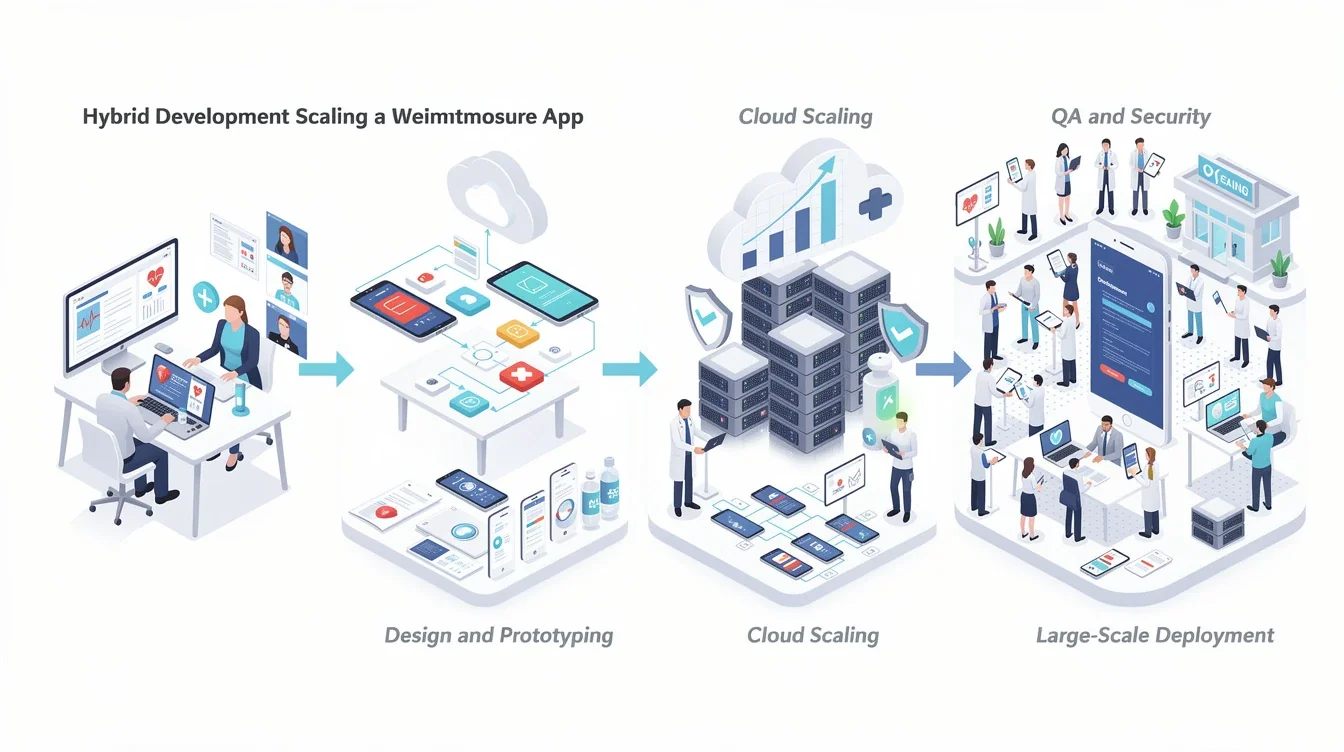
A hybrid team isn’t just about geography—it’s about roles, trust, and workflow. Our first step was to map out responsibilities. Core US team members owned architecture, compliance reviews, and roadmap priorities. Our overseas team (in Eastern Europe and South Asia) took on feature implementation, QA, and routine maintenance.
Communication was key. We instituted daily stand-ups, weekly sprint reviews, and clear escalation paths. All code went through the same rigorous pull request process, with automated compliance checks. Importantly, we kept all patient data and production access onshore, using anonymized data in overseas development environments.
The payoff? We tripled development velocity within two months, dramatically reducing bottlenecks and burn-out. The hybrid model also gave us 24-hour coverage: when the US team logged off, the overseas crew picked up, ensuring bugs and features never sat idle.
Pro tip: Invest in onboarding and documentation. Cross-border teams thrive on clarity, not guesswork.
Tackling Healthcare-Specific Hurdles
Scaling any app is tough, but healthcare brings extra baggage. HIPAA and HITECH compliance, device fragmentation, and integration with legacy EHRs can slow even the best teams. Our hybrid approach helped us tackle these head-on.
With compliance, our US-based leads owned all policy updates and code reviews. We built automated test suites to catch privacy or security violations before code hit production. For EHR integrations, we used local experts for initial architecture, then handed off repetitive API work to overseas team members—speeding delivery without risking quality.
Device fragmentation was another hurdle. Our overseas QA engineers tested across dozens of devices and OS versions, reporting issues the US team simply couldn’t catch alone. This democratized quality assurance, reducing support tickets and boosting user satisfaction.
Pro tip: Use your overseas QA team to expand device and edge-case coverage—especially critical in healthcare.
Managing Costs and Maximizing Value
One of the biggest myths about hybrid teams is that they’re just a cost-saving play. The reality is more nuanced. Yes, augmenting your team with overseas talent is more affordable than hiring all local, but the real value is in flexibility and speed.
For our client, we were able to:
- Stretch budget further by assigning routine tasks overseas
- Reserve high-value, high-risk work for US-based leads
- Spin up new features and experiments without long lead times
This allowed us to run more “shots on goal”—launching and iterating on new features quickly, then doubling down on what worked. With consistent sprint reviews and transparent budgeting, the client always knew where their money was going and why.
Pro tip: Track not just cost per hour, but cost per feature delivered. Hybrid teams shine on output, not just expense.
Lessons Learned and Best Practices
Scaling a healthcare app with a hybrid team isn’t a magic bullet—it takes intentional planning, robust processes, and a growth mindset. Here’s what we learned:
Culture matters. Invest in team-building, even across borders. Celebrate wins, share feedback, and foster a sense of shared mission.
Documentation is your backbone. With team members in multiple time zones, clear specs and process docs prevent confusion and rework.
Compliance is non-negotiable. Moving fast is great, but never skip privacy reviews or security checks. Automate what you can, but always keep a human in the loop.
Start small, scale fast. Begin with a lean hybrid team, prove the model, then ramp up as trust and systems mature.
Pro tip: Schedule regular “retros” with your full hybrid team. Continuous improvement pays huge dividends over time.
Conclusion
Scaling a healthcare app is never easy, but a well-structured hybrid development team can turn daunting challenges into a strategic advantage. At Digital Minds, we’ve seen firsthand how combining US-based leadership with skilled overseas partners unlocks speed, flexibility, and cost control—without compromising on compliance or quality.
If you’re facing a growth spurt, mounting feature backlog, or rising development costs, consider the hybrid model. It’s not just about saving money—it’s about building resilient, scalable teams that deliver results in the real world of healthcare technology. And as always, success comes down to the right people, the right process, and a relentless focus on user trust.
Ready to scale smarter? Let’s build the future of healthcare, to gether.


1 Comment
[…] everything from MVP launches to massive SaaS rollouts. But there’s a not-so-obvious rhythm to scaling these distributed teams: the seasonal hiring cycle. Understanding when, where, and how to hire […]
Your comment is awaiting moderation.
[…] Scaling a digital product today means going global—both in market reach and talent sourcing. For startups and enterprises alike, one of the most impactful decisions is how to build and manage your software development capability. Do you opt for a dedicated offshore team, or do you partner with a managed development center? At Digital Minds, we’ve guided dozens of clients through this crossroads, helping them launch MVPs, extend legacy systems, and accelerate innovation. But how do you know which model fits your goals, budget, and appetite for hands-on management? Let’s break down the differences, benefits, and trade-offs so you can make a confident, cost-conscious choice. […]
Your comment is awaiting moderation.
[…] activation. At Digital Minds, we’ve seen how small words can make a big impact, especially when scaling digital products for startups and enterprises alike. Let’s explore how strategic microcopy […]
Your comment is awaiting moderation.
https://shorturl.fm/iDDSw