
Every SaaS founder and product manager knows the rush of inspiration—a killer feature idea that seems destined to wow users and fuel growth. But in today’s hyper-competitive digital landscape, betting on gut instinct is risky business. At Digital Minds, we’ve seen too many startups and SMBs burn through budgets and months of development on features that never find traction. The solution? Validate before you build.
Let’s dive into practical, proven strategies for validating SaaS features before your team commits to a full (and expensive) build. This approach not only conserves resources, but also aligns your product roadmap with genuine customer needs. Whether you’re a founder, CTO, or product owner, these steps will help you launch smarter, faster, and with confidence.
Why Feature Validation Matters

It’s tempting to believe you know what your users want—especially if you’re solving a problem you’ve faced yourself. But assumptions can be costly. Feature validation is the process of testing ideas early, using data and direct feedback to determine if a feature is worth building. The goal isn’t just to avoid wasted effort; it’s to maximize ROI by focusing on what really moves the needle for your users.
Validation is even more critical for SaaS platforms, where each new feature can impact system complexity, support overhead, and user adoption. Building the wrong thing doesn’t just mean wasted code—it can lead to user churn, missed revenue, and technical debt that slows future growth.
Pro tip: The best SaaS teams treat validation as ongoing insurance for their roadmap, not a one-off gate to pass.
Discovery: Understanding the Real User Need
Before you sketch a wireframe or fire up your code editor, ask: Do users actually want this? The first step is getting close to your target audience. At Digital Minds, we recommend starting with structured user interviews, surveys, and careful analysis of your current product analytics.
Listen for recurring pain points, not just feature requests. Sometimes, users ask for “more reports” when what they really want is actionable insights. Digging deeper—asking “why” repeatedly—helps uncover the core problem your feature might solve.
Don’t stop at qualitative feedback. Quantitative data, like usage patterns or drop-off points in your app, can reveal where your users are struggling or disengaging. These insights help you frame your feature hypothesis in terms of real user value, not just internal hunches.
Pro tip: Frame your feature idea as a hypothesis—“If we add X, users will achieve Y”—and look for evidence to support or refute it.
Prototyping and MVP Testing
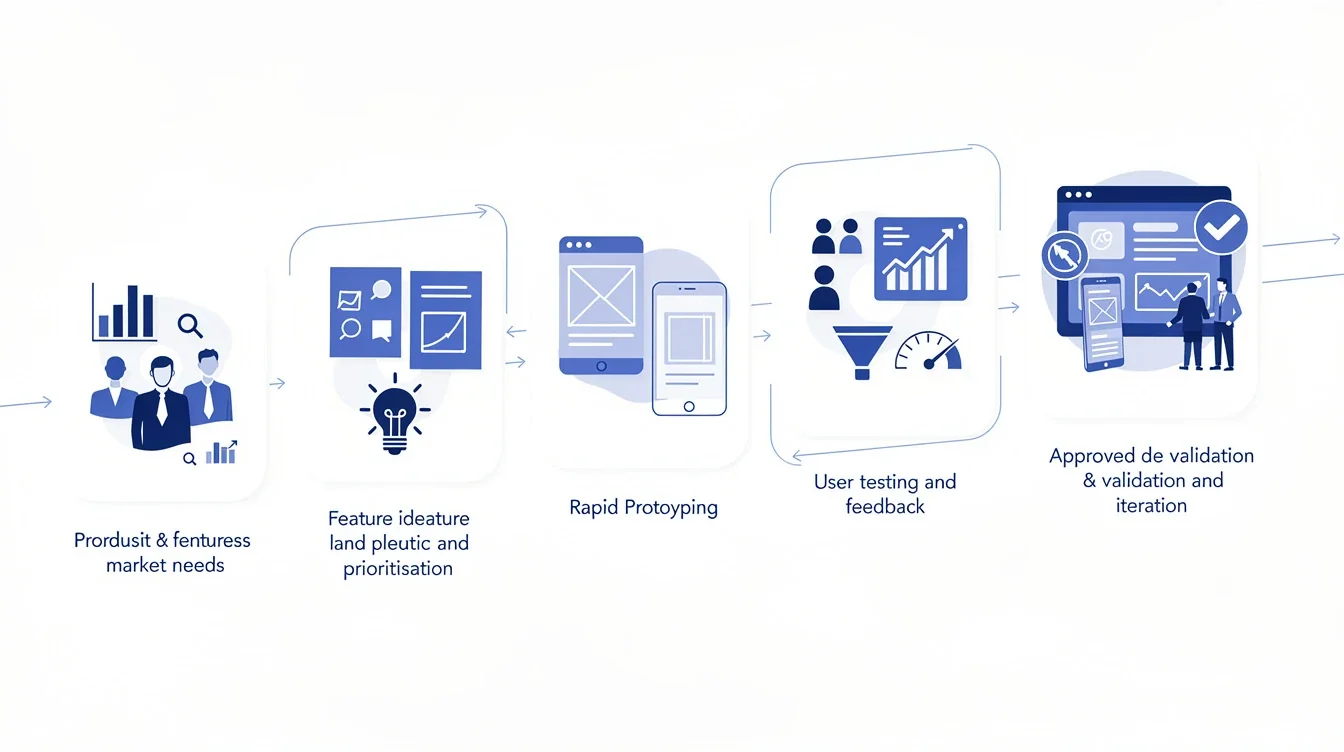
Once you’ve validated the problem, it’s time to test your solution—without building the whole thing. Prototyping and MVP (Minimum Viable Product) approaches let you gauge user interest and usability with minimal investment.
Depending on your feature, this might mean clickable wireframes, mockups, or even simple no-code tools that simulate the experience. Modern prototyping tools make it easy to share these concepts with users for quick feedback. If you’re debating between two designs or workflows, A/B test them with a small group to see which resonates.
For bigger bets, a true MVP—something users can interact with, even if it’s rough around the edges—can provide real-world data. Track adoption, engagement, and qualitative feedback. If users are willing to jump through hoops to use your half-baked prototype, that’s a powerful signal you’re on the right track.
Pro tip: Don’t aim for perfection here. The goal is to learn, not to impress. Rough sketches often spark more honest feedback than slick, high-fidelity mockups.
Lean Experiments for Early Validation
Sometimes, the fastest way to validate a feature is with lean experiments that mimic the final experience without actually building it. Techniques like “fake door” tests—where you add a button or menu item for the new feature, then measure clicks and collect feedback—can gauge interest before a single line of backend code is written.
Smoke tests, landing pages, and concierge MVPs (where you manually fulfill a feature behind the scenes) are all part of the lean validation toolkit. These approaches are especially valuable for SaaS products, where user expectations are high and release cycles are tight.
The key is to set clear success criteria up front. For example, “If 10% of users click the new feature prompt within a week, we’ll proceed to prototype.” This data-driven approach keeps your team honest and focused.
Pro tip: Be transparent with your users during these experiments. A simple message like “We’re exploring a new feature—interested?” can turn early testers into long-term fans.
Calculating Cost and Impact
Before you greenlight a feature for full development, it’s essential to balance user enthusiasm with the realities of your business. Not every validated feature is worth building right now. Consider the development effort, opportunity cost, and potential impact on your SaaS metrics.
At Digital Minds, we help clients weigh technical complexity against strategic value. Will this feature drive growth, increase retention, or open new markets? Or will it add support and maintenance burdens that distract from your core offering?
Prioritize features that align with your business goals and have clear paths to ROI. For features that pass validation but aren’t mission-critical, consider parking them in a public roadmap for future exploration.
Pro tip: Use a simple scoring system—combining user demand, business impact, and build effort—to help your team make objective, data-driven decisions.
Building a Culture of Continuous Validation
Feature validation shouldn’t be a checkbox; it’s a mindset. The most successful SaaS companies bake validation into every stage of product development. This means regularly soliciting user feedback, reviewing analytics, and running experiments—not just before the initial build, but throughout the product lifecycle.
If you’re working with overseas development teams or distributed squads (as many Digital Minds clients do), clear validation practices provide alignment and reduce miscommunication. Everyone knows why a feature is being built, what it’s supposed to achieve, and how success will be measured.
Make it easy for team members to suggest experiments or share user insights. Celebrate wins—features that pass validation and gain traction—as well as lessons learned from the “no-go” features you wisely skipped.
Pro tip: Document your validation process and share outcomes openly. Transparency builds trust across your team and with your user community.
Conclusion
Validating SaaS features before a full build isn’t just about saving time and money—it’s about building products your users truly value. By grounding your roadmap in real-world data and feedback, you’ll reduce risk, accelerate growth, and make smarter investments. At Digital Minds, we believe the best SaaS solutions are born from a steady rhythm of discovery, prototyping, experimentation, and reflection.
So next time inspiration strikes, pause before you code. Validate first. Your users—and your bottom line—will thank you.