
As the digital landscape evolves, so does the way we build software. For startups, SMBs, and enterprise clients alike, the question isn’t just how to develop products, but where and with whom. At Digital Minds, we’re often asked: “Which is more cost-effective—hybrid or fully remote development?” The answer isn’t always simple. Your decision will have ripple effects on budget, productivity, and the ultimate success of your MVP or mature product. Let’s dive into the cost considerations that matter most when choosing between hybrid and fully remote development models.
Understanding Hybrid and Fully Remote Models

Before weighing costs, it’s important to define what we mean by hybrid and fully remote development teams. Hybrid teams mix on-site and remote work—typically some team members work from a central office while others log in from elsewhere, or all team members split their time between office and remote locations. Fully remote teams, on the other hand, are distributed entirely, with everyone working from different locations—often across multiple time zones and even countries.
Hybrid setups can offer the best of both worlds—physical collaboration for brainstorming and relationship-building, with the flexibility and reach of remote work. Fully remote models maximize talent access and cost savings, but come with their own management and communication challenges.
Pro tip: Define clear communication protocols from day one, regardless of your chosen model, to keep collaboration smooth and expectations aligned.
Comparing Direct and Hidden Costs
When most think about development costs, salary is the obvious line item. But the total cost of building a high-performing software team goes well beyond paychecks. Let’s break down the primary cost areas for each model:
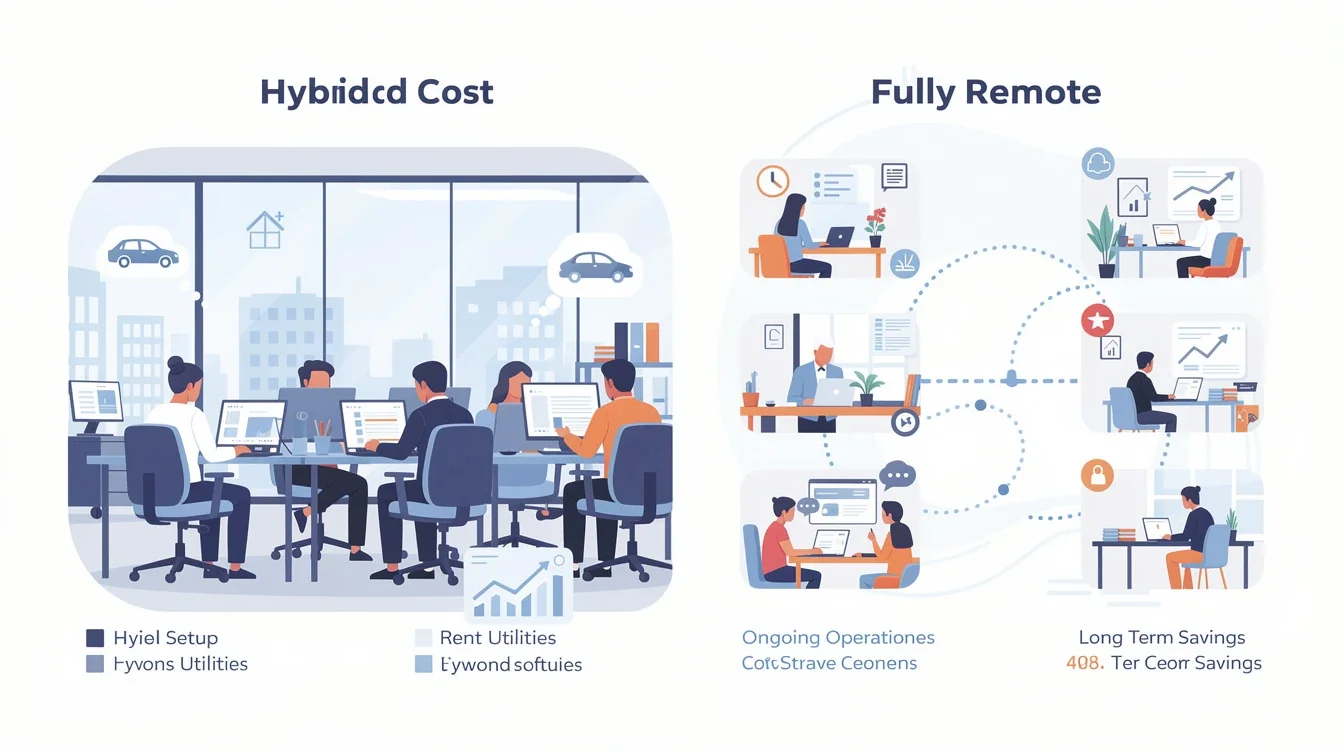
Hybrid Development Costs:Hybrid teams usually require some form of office space. This means rent, utilities, office supplies, and potentially relocation or travel expenses for team members who need to be on-site part-time. You’ll also need to budget for in-person events, which, while valuable for team cohesion, can add up.
Fully Remote Development Costs:
Fully remote teams eliminate the need for physical office space, resulting in significant savings. However, you might need to invest in better hardware, stipends for home office setups, premium collaboration software, and robust cybersecurity solutions. There are also costs associated with ensuring remote team members stay engaged and connected—think virtual events, asynchronous communication tools, and more structured project management.
What’s often overlooked are the hidden costs:
- Onboarding and ramp-up time can be longer for fully remote teams, especially if you’re hiring overseas and need to bridge cultural or language gaps.
- Process and management overhead increases with distributed teams, requiring more documentation, more frequent check-ins, and sometimes additional layers of management.
- Turnover risk may be higher in fully remote environments if employees feel disconnected or unsupported.
Pro tip: Don’t underestimate the long-term ROI of investing in robust remote onboarding and documentation—it pays off with faster ramp-up and lower turnover.
Talent Acquisition and Retention
Your development model directly impacts your access to talent—and the price you’ll pay for it. In the US, tech salaries are among the highest worldwide. Hybrid models typically draw from local markets, which can be limiting both in terms of cost and skill diversity.
With a fully remote approach, you can tap into global talent pools, including overseas teams with highly competitive rates and specialized expertise. This often results in lower labor costs, especially for ongoing or long-term projects. However, it also means you’ll need to navigate different employment laws, tax implications, and payment systems.
Retention is another critical factor. Hybrid environments can foster stronger company culture and loyalty through face-to-face interaction and shared experiences. Fully remote teams require deliberate investment in culture-building and engagement strategies. The cost of replacing a developer—recruiting, onboarding, and lost productivity—can quickly eat into any labor savings if team morale slips.
Pro tip: Consider a remote-first culture, even if you’re hybrid. Empower all team members equally, regardless of location, to boost retention and maximize talent ROI.
Productivity, Collaboration, and Project Velocity
It’s a common myth that remote teams are less productive. In reality, well-structured remote teams often outperform their in-office counterparts, especially when equipped with the right tools and processes. Productivity gains, however, aren’t automatic—they require discipline, clear expectations, and strong leadership.
Hybrid teams can benefit from spontaneous in-person collaboration, quick problem-solving, and easier mentorship. These advantages can shorten development cycles and reduce costly rework. But hybrid models also risk creating “in” and “out” groups, where remote team members feel left out of key conversations or decisions, hampering productivity in the long run.
Fully remote teams depend on asynchronous communication and clear documentation. When done right, this leads to fewer interruptions and more focused work, which can actually speed up delivery. The trade-off is that you may need to invest more in project management and coordination, particularly for complex or cross-functional projects.
Pro tip: Implement agile methodologies and regular retrospectives to surface and address productivity bottlenecks early, regardless of your team’s structure.
Security, Compliance, and Operational Risk
Security and compliance are non-negotiable, especially if you’re building products in regulated industries or handling sensitive data. Hybrid teams can centralize some aspects of security within a physical office, but must still account for remote-access risks. Fully remote teams face a broader attack surface: home networks, personal devices, and international regulations all add layers of complexity.
Operationally, hybrid teams are more exposed to disruptions like local weather events, transit strikes, or public health issues. Fully remote teams can be more resilient, but require robust backup plans for connectivity issues and clear protocols for handling incidents across time zones.
Both models require investment in secure development environments, VPNs, access controls, and incident response plans. The cost of a breach or compliance failure—regulatory fines, lost customer trust, and remediation—can dwarf any upfront savings.
Pro tip: Don’t skimp on security training and policy enforcement for remote and hybrid teams. The best technical controls are only as strong as your people and processes.
Scaling and Long-Term Flexibility
One of the greatest benefits of remote and hybrid models is the ability to scale rapidly as your product or business grows. Fully remote teams excel here: you can bring on talent in new regions at a fraction of the cost and ramp up quickly without expanding office space. This flexibility is especially valuable for startups and businesses with fluctuating needs—think MVP launches, pilot programs, or time-bound projects.
Hybrid teams can also scale, but growth is often limited by physical constraints—office capacity, local hiring pools, and commuting distances. Expanding to new locations means new leases, new legal entities, and higher overhead. However, if your business requires frequent in-person collaboration, hybrid scaling may be worth the premium.
Pro tip: Plan your team structure with future product stages in mind. What works for your MVP may not scale efficiently to enterprise levels, and vice versa.
Conclusion
The choice between hybrid and fully remote development models is ultimately a strategic one, shaped by your budget, project needs, and company culture. Hybrid teams offer valuable face-to-face collaboration but come with higher fixed costs. Fully remote teams unlock global talent and cost savings, but require thoughtful investment in processes, culture, and security.
At Digital Minds, our experience with clients from startups to enterprises has shown there’s no one-size-fits-all solution. The most successful teams are those that align their operating model with their growth goals—balancing cost with productivity, flexibility, and long-term sustainability.
Whether you’re looking to launch your MVP with a lean overseas team or scale an enterprise solution with hybrid collaboration, it pays to examine not just upfront costs, but the total impact on your business. With the right planning and support, both hybrid and fully remote models can drive exceptional results—without breaking the bank.